
Bathroom Refurbishment for Landlords: Where to Spend
What Is Actually Worth Spending Money On?
Property: London rental flat.
Room: One main bathroom.
Problem: Tired suite, ageing tiles, limited storage, unreliable shower and finishes that are becoming harder to maintain.
Objective: Refurbish the bathroom without turning a rental property into an unnecessarily expensive showroom.
That is a very different brief from designing a bathroom for your own home.
A landlord does not need to choose the cheapest possible products. Nor does it usually make sense to install every premium feature available.
The useful middle ground is a bathroom that looks properly refurbished, survives repeated everyday use, is straightforward to clean and does not create avoidable maintenance problems between tenancies.
So let us treat the refurbishment like an investment decision rather than an interior-design exercise.
Investment Decision 1: Spend on the Parts That Are Expensive to Revisit
Some bathroom decisions are relatively easy to change later.
A mirror can be replaced. A toilet-roll holder can be changed. A tired cabinet handle can be upgraded in an afternoon.
Other mistakes are buried behind tiles, beneath floors or inside walls.
Those are the areas where saving a relatively small amount during the refurbishment can create disproportionately expensive work later.
For a rental bathroom, money is generally better directed towards:
- sound plumbing and reliable connections;
- proper preparation of walls and floors;
- appropriate waterproofing around wet areas;
- good drainage;
- effective ventilation;
- accurate tiling;
- sanitaryware fitted securely and correctly.
None of these items is particularly exciting in a property listing.
They are exactly what helps prevent the bathroom becoming a recurring maintenance call.
A complete bathroom fitting and remodelling service is particularly useful for rental refurbishments because the plumbing, preparation, tiling and final fitting can be treated as one scope of work rather than a series of disconnected jobs.
Investment Decision 2: Keep the Visible Specification Good, but Replaceable
A rental bathroom still needs to look attractive.
Tenants notice a clean contemporary bathroom immediately, and a visibly neglected one can make the rest of a property feel poorly maintained.
But attractive does not have to mean highly specialised.
For example, a straightforward vanity unit with sensible storage may be more useful than bespoke cabinetry. Good-quality chrome or brushed-metal taps may be easier to replace than an unusual designer finish that is difficult to match several years later.
The same logic applies to sanitaryware.
There is little benefit in choosing the cheapest toilet or basin available if fittings feel flimsy and replacement parts are difficult to obtain.
At the same time, a rental bathroom rarely needs an expensive statement basin simply because it photographs well.
The ideal specification sits in the boringly useful middle: reputable, clean-looking, durable and straightforward to repair or replace.
The Landlord Specification Sheet
| Bathroom element | Recommended approach | Why |
|---|---|---|
| Shower | Reliable, uncomplicated system | Used heavily and expensive to troubleshoot if concealed components fail. |
| Bath | Keep where it suits the tenant market | Useful in family properties; less essential in some smaller flats. |
| Vanity | Practical storage over decorative complexity | Reduces clutter and improves everyday usability. |
| Tiles | Durable, readily available format | Easier to maintain or source replacements later. |
| Toilet | Good-quality standard model | Reliable parts and easier future servicing. |
| Lighting | Bright and simple | A rental bathroom needs good practical illumination more than complicated mood lighting. |
| Extraction | Do not under-specify | Helps control condensation regardless of how consistently tenants open windows. |
| Storage | Build enough in from the start | Prevents tenants adding awkward freestanding units later. |
This does not mean every rental bathroom should look identical.
The property itself still matters. A premium apartment and a straightforward one-bedroom rental may justify different finishes.
The principle is simply to choose products according to how they will perform over several tenancies, not only how they look on completion day.
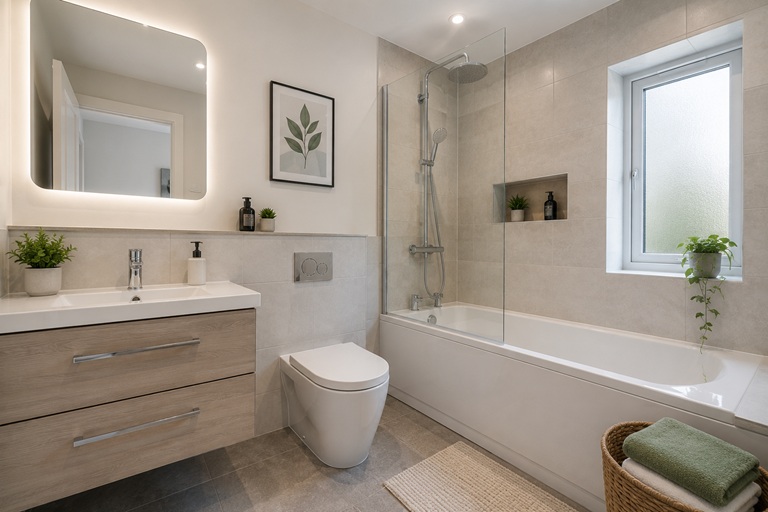
Where Landlords Commonly Overspend
Imagine £2,000 remains in the refurbishment budget after the essential work has been specified.
There are several ways to spend it.
You could choose designer brassware, a dramatic freestanding bath, intricate mosaic walls and highly decorative lighting.
Or that same money could improve the shower, increase storage, upgrade extraction, provide better lighting and allow more thorough preparation before tiling.
For most rental properties, the second package is likely to have more value over time.
This is especially true with features that create additional maintenance.
A freestanding bath pushed close to a wall can leave difficult cleaning gaps. Very detailed mosaic installations introduce far more grout. Unusual finishes may be harder to match if one component is damaged.
None of those products is inherently wrong.
They simply need to justify themselves against the purpose of the property.
Where Landlords Commonly Underspend
The opposite mistake is treating every invisible item as somewhere to save money.
That can be dangerous in a bathroom because many of the expensive failures start in areas tenants never see.
Poorly prepared walls can affect tiles. Weak flooring can compromise the finished surface. Inadequate wet-area preparation can create much larger problems than the initial saving.
Cheap extraction is another false economy.
A landlord cannot control whether every tenant opens the window after every shower. Good ventilation gives the room a better chance of managing moisture under normal real-world use.
Tiling deserves similar attention. A neutral tile does not need to be expensive, but it still needs a stable base, sensible layout and accurate installation. The company’s bathroom flooring and tiling service covers the preparation as well as the finished surface.
The Five-Year Maintenance Forecast
Now imagine the bathroom after the contractor leaves.
Month 1: everything looks new. At this point, almost any specification can appear successful.
Year 1: frequently used items start revealing whether they were sensible choices. Storage capacity matters. Shower performance matters. Sealant and grout receive daily use.
Year 3: easily replaceable products become valuable. If a tap component or toilet fitting needs attention, standard parts can make maintenance simpler.
Year 5: the real quality of the refurbishment becomes clearer. A bathroom built on good preparation may still feel solid even if cosmetic items show normal wear. A room where money was concentrated only on visible products can be far less impressive once the initial shine disappears.
This longer view changes what “good value” means.
The cheapest refurbishment is not necessarily the one with the lowest starting price. The premium refurbishment is not necessarily the one with the most expensive fittings.
The useful measure is how much avoidable work the bathroom creates after it has been put back into service.
One More Decision: Refurbish Between Tenancies or While Occupied?
Where possible, a substantial bathroom refurbishment is often easier to manage when the property is vacant.
The bathroom may be unusable for parts of the project, and strip-out, plumbing alterations, tiling and finishing create disruption that is considerably easier to coordinate without somebody relying on the room every day.
A vacant period also allows the landlord to address related issues together instead of repeatedly returning for separate repairs.
That does not mean every tired bathroom requires a complete rebuild.
If the underlying installation remains sound, targeted replacement may be enough. But once several elements are failing together, repeatedly patching the room can begin to make less financial sense than a properly planned refurbishment.
If you are deciding how extensive the work should be, the bathroom renovation cost guide can help put the major cost variables into context before committing to a specification.
Bathroom Fitting Experts can inspect a rental bathroom, identify the work worth retaining or replacing and provide a quotation based on the actual condition of the room. Landlords and property owners planning work across London can request a free bathroom refurbishment quote before deciding how much to invest.
Landlord decision: spend first on what keeps the bathroom working, second on what keeps it easy to maintain, and only then on what makes it look expensive.