
Poorly Fitted Bathroom? What Goes Wrong and Why
Bathroom Renovation Gone Wrong: Rebuilding a Poorly Fitted Bathroom
Room: Main bathroom
Age of refurbishment: Approximately 18 months
Original appearance: Modern, fully tiled, apparently complete
Reported problems: Loose floor tile, water staining outside the shower, cracked grout, slow drainage and a vanity drawer that no longer closes properly
Initial homeowner assumption: Several small unrelated defects
Actual finding: One badly coordinated installation producing several different symptoms
This is a fictional case, but the pattern is realistic.
A bathroom does not have to look obviously disastrous to have been fitted badly. In fact, many installation problems remain hidden while the room is new. Fresh silicone disguises poor junctions. New grout conceals movement. A slightly incorrect floor fall may not become irritating until the shower has been used hundreds of times.
The interesting part is not simply identifying what failed.
It is working out which earlier decision allowed the failure to happen.
Evidence Log
EVIDENCE 01 — The loose tile beside the shower
One floor tile moves slightly when pressure is applied near its corner.
Replacing that tile alone would be the quickest response. It would also be the wrong place to start.
The movement suggests that something beneath the finished surface needs investigating. The substrate may not have been sufficiently stable, the tile may not have achieved adequate adhesion, or localised movement may have developed around previous floor alterations.
The tile is the symptom. The floor beneath it is the question.
EVIDENCE 02 — Grout cracking in the same area
Now the first defect begins to look less isolated.
Grout beside the loose tile has cracked as well. That makes movement more likely than a simple cosmetic defect.
Good bathroom tiling and flooring relies heavily on what happens before the decorative surface is installed. If the base flexes or contains badly repaired areas, grout and tiles may eventually reveal that movement.
EVIDENCE 03 — Water appearing outside the shower
The homeowner originally blames the glass screen.
That is plausible, but testing shows water is not simply splashing around the end of the glass.
There is persistent dampness close to the shower threshold after longer use.
Possible causes now include failed sealing, poor detailing where the shower meets the surrounding floor, unsuitable falls, or a weakness in the waterproofing arrangement underneath.
The correct repair cannot be chosen until the finished surface is opened sufficiently to establish which one is responsible.
EVIDENCE 04 — The shower drains, but not quickly enough
The shower never completely floods.
Instead, water slowly builds across the tray before clearing several minutes later.
That is the kind of defect people sometimes tolerate because the shower technically still works.
But slow drainage changes how much standing water reaches joints, corners and seals during every use. It can magnify weaknesses elsewhere in the installation.
The waste route, trap and connection therefore become part of the investigation.
EVIDENCE 05 — The vanity is no longer square
A drawer that once closed cleanly now rubs against the cabinet.
The furniture has not suddenly changed shape for no reason.
Moisture may have reached the unit, the wall fixing may have moved, or the surrounding surface may no longer be behaving as it did when the vanity was installed.
Five small complaints have now become one construction problem.
Root-Cause Matrix
| Visible symptom | Possible hidden cause | What a proper repair may require |
|---|---|---|
| Loose floor tile | Movement, inadequate adhesion or poor substrate preparation | Lift surrounding tiles and inspect the floor rather than replacing one tile blindly |
| Cracked grout | Movement beneath the tiled finish | Stabilise the underlying area before reinstating grout and tiles |
| Moisture outside shower | Failed sealing, waterproofing defect or incorrect water management | Open the affected junction and rebuild it correctly |
| Slow shower drainage | Restricted waste, poor pipe arrangement or drainage issue | Access and correct the waste system rather than repeatedly using drain cleaner |
| Misaligned vanity | Moisture damage, fixing movement or distorted surrounding material | Remove, assess and refit only after the background problem has been corrected |
This is why repair quotations can vary so widely.
One contractor may price replacing the visible damaged items. Another may price investigating and rebuilding the failed construction beneath them.
Those are not equivalent scopes of work.
When a bathroom has several related defects, a complete bathroom fitting and remodelling assessment can be more useful than treating each symptom as an independent repair.
Corrective Scope of Works
The homeowner now has a choice.
The bathroom can continue receiving individual repairs as each symptom appears, or enough of the installation can be opened to establish what actually needs rebuilding.
For this case, the corrective scope is agreed as follows.
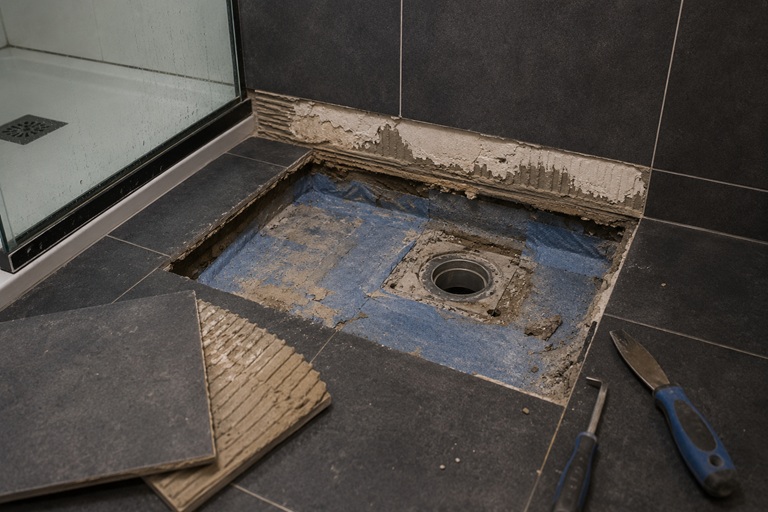
WORK PACKAGE A — Controlled strip-out
The objective is not to smash the entire bathroom apart automatically.
Tiles and finishes around the affected shower and floor areas are removed carefully enough to expose the substrate, drainage connections and vulnerable junctions.
The vanity is temporarily removed so that the wall and flooring around it can be inspected.
WORK PACKAGE B — Establish what remains sound
This is where a corrective refurbishment differs from an unnecessary complete rebuild.
Sound sections should not be replaced merely because another part of the bathroom was fitted poorly.
The inspection therefore separates the room into three categories:
- retain — properly installed and unaffected;
- repair — usable once a local defect is corrected;
- replace — compromised, damaged or unsuitable for reinstatement.
WORK PACKAGE C — Repair the hidden failures first
The drainage problem is corrected before the new shower finish is considered.
Unstable floor sections are repaired before new tiles are ordered.
Wet-area preparation is reinstated before decorative surfaces return.
This order matters.
There is no value in producing beautiful tile cuts around a shower whose waste still cannot clear water properly.
WORK PACKAGE D — Rebuild the finish around the corrected construction
Only once the underlying work is signed off are tiles, furniture and visible fittings reinstated.
At this point, the project becomes a design exercise again. Matching existing finishes may be possible if spare tiles remain available. If not, the repaired area may need a deliberately different but complementary treatment rather than a poor attempt at an exact match.
Where larger design changes become necessary, the company’s bathroom design service can help rework the affected area instead of trying to recreate a layout that contributed to the original problem.
Salvage Decision
| Item | Decision | Reason |
|---|---|---|
| Toilet | Keep | Unrelated to the failure and functioning correctly |
| Basin | Keep | No damage and fittings remain sound |
| Vanity cabinet | Assess after removal | Possible moisture exposure |
| Shower screen | Reuse if undamaged | Glass itself is not the source of the problem |
| Affected floor tiles | Replace | Need removal to repair the substrate beneath |
| Shower-area tiles | Partial replacement | Required to rebuild compromised junctions |
| Drainage components | Correct as required | Performance is inadequate |
This approach protects the homeowner from two opposite mistakes.
The first is patching too little and leaving the cause behind.
The second is ripping out thousands of pounds of perfectly sound bathroom simply because one section has failed.
Corrective work should be investigative before it becomes destructive.
The financial difference between a localised reconstruction and a full refit can be substantial, which is why the site’s bathroom renovation cost guide is useful when considering whether extensive remedial work is approaching the point where a wider refurbishment makes more sense.
Close-Out Report
Original complaint: loose tile, cracked grout, water staining, slow drainage and misaligned vanity.
Incorrect response: regrout the crack, reseal the shower, adjust the drawer and replace the loose tile.
Correct response: investigate why several failures appeared in the same part of a relatively new bathroom.
That distinction matters because bathrooms are systems.
The tiles depend on the surfaces behind them. The shower depends on drainage and waterproofing. Furniture depends on dry, stable surroundings. Silicone can protect a correctly formed junction, but it cannot compensate indefinitely for construction that was wrong before the sealant tube was opened.
A good repair does not ask, “How do we hide this defect again?” It asks, “Why did this defect appear in the first place?”
If you are dealing with a poorly fitted or failing bathroom in London, Bathroom Fitting Experts can inspect the existing installation and establish whether the sensible route is targeted remedial work or a broader refurbishment. You can request a bathroom fitting quote after the existing room and the scope of corrective work have been assessed.