
What Makes Bathroom Tiling Look Professionally Fitted?
Bathroom Tiling: The Details That Separate an Average Finish From a Professional One
Two bathrooms can use the same tiles and still look completely different when finished.
The difference is often not the price of the tile. It is where the first tile was placed, how the cuts were planned, what happened in the corners, whether grout lines continue cleanly across the room and how carefully every awkward edge was resolved.
Professional tiling tends to feel effortless because the difficult decisions have disappeared into the finished surface.
So instead of discussing tile styles or trends, imagine walking into a newly completed bathroom and inspecting it properly. Where would you look to tell whether the tiling has genuinely been thought through?
Stand in the Doorway Before Looking at a Single Grout Joint
Your first impression comes from the overall layout.
Do the tiles feel balanced across the main wall? Does a central feature sit naturally within the pattern? Are there awkward narrow strips pushed into obvious areas?
This is decided during setting-out, long before most of the tiles are installed.
An experienced tiler does not simply begin at one edge and hope the final tile works when the opposite wall is reached. The room is measured, reference points are established and the pattern is considered against the features that will interrupt it.
Those interruptions include the vanity, shower tray, bath, window, niches, toilet frame, concealed valves and even the doorway itself.
The best starting point is often the one that creates the best ending points.
This is why tile planning should be coordinated with the wider bathroom design rather than treated as a decorative decision made after everything else has already been fixed in place.
Now Look Straight at the Basin Wall
The basin wall is often one of the strongest visual areas in the room.
There may be a vanity, mirror, wall-mounted taps and lighting all competing for alignment.
This is where poorly planned grout lines become especially noticeable.
A vertical joint that sits almost—but not quite—on the centreline of the basin can make the whole wall feel slightly wrong. A narrow tile cut trapped between a vanity and the corner can draw the eye every time you enter the room.
The solution is not always perfect symmetry. Some rooms simply do not allow it.
The skill lies in deciding which visual relationships matter most and allowing the less important areas to absorb the compromises.
Move Closer to the Corners
Corners reveal workmanship quickly.
Tiles rarely arrive at the corner at their full factory width. Cuts have to meet, grout joints need to remain controlled, and any irregularities in the wall become harder to hide.
A professional finish should look intentional rather than squeezed into place.
This becomes more demanding when walls are not perfectly square, which is common in older London properties.
The tiler may need to adjust cuts gradually so that one badly shaped wall does not create an obviously tapered tile from floor to ceiling.
Internal corners also need appropriate finishing because different surfaces can move slightly relative to one another.
What looks like a tiny junction is actually one of the places where careful preparation and finishing matter most.
Stop at the Shower Controls
A shower wall contains several interruptions.
There may be a mixer valve, shower outlet, hand shower connection, controls and perhaps a recessed niche.
Each one requires a cut.
Those cuts should be neat enough that the trim plates and fittings cover them comfortably without enormous gaps hidden behind the hardware.
Good work here depends partly on the plumbing having been positioned accurately before tiling begins.
If the valve is badly aligned or sits awkwardly against a tile joint, the tiler is forced to solve a problem created earlier in the project.
That is one reason a complete bathroom fitting and remodelling service can be valuable: plumbing, preparation and tiling can be coordinated instead of each trade working around decisions made independently.
Run Your Eye Around a Shower Niche
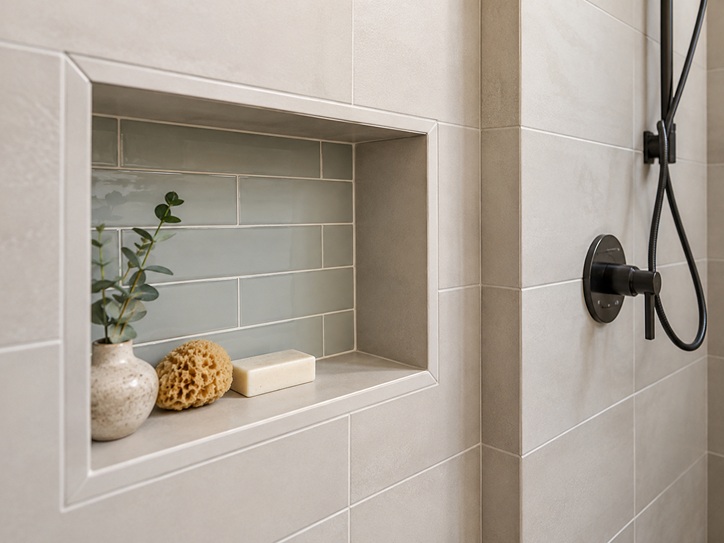
A recessed niche is one of the best places to inspect attention to detail.
It introduces extra corners, horizontal surfaces, vertical returns and edges into one small area.
The niche needs to fit the tile layout rather than appearing as though it was cut randomly into the finished wall.
The internal pieces should be neatly sized. The front edge needs a controlled finish. The base should deal with water sensibly rather than creating a shelf where it permanently collects.
Even the height of the niche can affect the appearance of the tile pattern around it.
That is why features such as niches should ideally be planned before the walls are closed and waterproofed, not requested when most of the tiling is already complete.
Crouch Down and Look Along the Floor
From standing height, a tiled floor may look perfectly flat.
From lower down, differences between adjacent tiles become easier to see.
Tile edges should relate cleanly to one another without obvious lips that catch the eye—or your foot.
Large-format tiles can make this particularly demanding because a tiny variation in the substrate can become visible across a much larger surface.
This is why floor preparation is part of good tiling.
The flatter and more stable the base, the more control the installer has over the finished surface.
The company’s bathroom flooring and tiling services cover both the visible finish and the preparation required to support it.
Follow One Grout Line Across the Room
Choose one grout joint and follow it.
Does it continue logically from one wall to the next? Does it line up with the floor where the design intended it to? Does it suddenly change width?
Grout lines are small individually but powerful collectively.
When they are consistent, your eye reads the tiled surface as one organised composition.
When they vary unnecessarily, the room can look unsettled even if you cannot immediately explain why.
Tile spacers and levelling systems can help, but they do not replace careful setting-out or accurate installation.
The grout itself also needs to be finished consistently. Joints that are washed too deeply in some areas or left heavy in others can make even expensive tiles appear poorly installed.
Look at the Cuts Nobody Posts on Instagram
Bathroom photographs usually focus on the centre of a feature wall.
Professional workmanship is often better judged at the edges.
Look behind the door. Around the radiator pipes. At the bottom of the toilet boxing. Where tiles meet a window reveal. Around the bath panel. Beside the shower screen.
These are the places where there is less room to hide inaccurate cuts.
A professional result should not collapse in quality simply because the area is less visible.
This does not mean every cut will be perfectly identical. Real rooms contain uneven walls, irregular angles and fixed services.
It means the solution should look controlled rather than improvised.
Check Every Exposed Edge
Tile edges appear around niches, half-height walls, external corners, window reveals and sometimes the end of a tiled section.
How those edges are finished has a surprisingly large influence on the room.
Depending on the tile and design, the solution may involve trim, a carefully finished tile edge or another deliberate detail.
The important word is deliberate.
An edge should look as though somebody decided how it would finish before the tile reached it.
Last-minute trim choices can clash with brassware, screens or other finishes and make an otherwise cohesive bathroom feel less resolved.
Turn the Lights On
Lighting can expose things daylight hides.
Wall lights, illuminated mirrors and ceiling spots can cast light across tiled surfaces at shallow angles.
That light may reveal uneven tile faces, inconsistent joints or walls that were not prepared adequately.
This is particularly noticeable with glossy finishes because reflections exaggerate changes in angle.
Lighting should therefore be considered during the design stage not only for atmosphere and usability, but also because it becomes part of how the finishes are visually experienced.
Finally, Stop Looking at Individual Tiles
After inspecting every detail, step back again.
The best tiled bathrooms do not make you think constantly about tile cutting, grout widths or edge trims.
Everything simply feels aligned.
The tile pattern supports the bath or shower. The grout lines do not fight with the furniture. Corners do not draw unnecessary attention. Niches feel like part of the design instead of holes cut into it.
That sense of calm is the result of hundreds of very small decisions.
Professional bathroom tiling is not about making one spectacular cut. It is about making every ordinary junction look as though it was always meant to be there.
The price of tiling can vary according to tile size, pattern, preparation and the amount of detailed cutting required. If you are budgeting for a complete project, the bathroom renovation cost guide explains how the different parts of a refurbishment contribute to the final figure.
Bathroom Fitting Experts can handle preparation, waterproofing, tiling and the wider bathroom installation as one coordinated project. If you are planning a bathroom refurbishment in London, you can request a free bathroom fitting quote and discuss the finish you want to achieve.