
Where Does Your Bathroom Renovation Budget Go?
Bathroom quotations can be confusing because two projects that look similar in photographs can have very different costs.
One homeowner might keep the existing layout, replace the suite and retile straightforward walls. Another may move the toilet, install a walk-in shower, correct damaged flooring, add new lighting and fit bespoke furniture.
Both are called bathroom renovations, but they are not the same job.
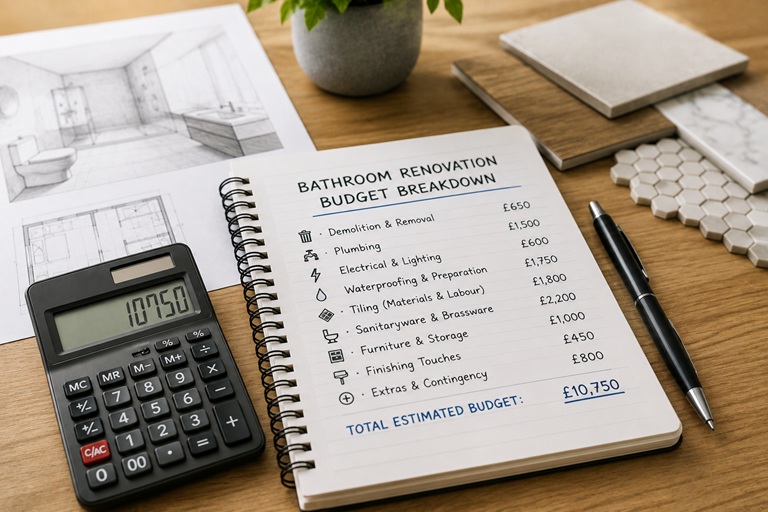
A better way to understand bathroom fitting costs is to stop thinking about the quotation as one large number. Instead, imagine your budget being divided into several separate pots. Each pot pays for a different part of the room, and changing one decision can affect several others.
Here is where the money in a full bathroom refurbishment actually goes.
Budget Pot 1: Removing What Is Already There
Before a new bathroom can be built, the old one normally has to come out.
That may involve disconnecting and removing the toilet, basin, bath or shower, furniture, flooring and tiles. Old materials then need to be handled and removed from the property responsibly.
Strip-out can look simple from the outside, but the amount of work varies considerably.
A lightly fitted bathroom with painted walls and a straightforward suite may be relatively quick to clear. A room with floor-to-ceiling tiles, boxed-in plumbing, heavy flooring or several previous layers of refurbishment can require much more time.
This stage also exposes the condition of the room underneath, which leads directly into the next part of the budget.
Budget Pot 2: Fixing the Things You Never Planned to Buy
Homeowners naturally enjoy choosing the visible parts of a bathroom: taps, tiles, vanity units, mirrors and showers.
Unfortunately, some of the most important spending happens on items you will never notice once the project is finished.
Removing old finishes may reveal uneven walls, damaged plasterboard, rotten timber, weak flooring, previous leaks or unsuitable surfaces beneath the tiles.
Those issues cannot simply be covered over because a new bathroom is being installed.
Preparation work protects everything that will eventually sit on top of it. Spending money correcting a weak floor or unsuitable wall surface is considerably more valuable than installing expensive finishes over a poor base.
This is also why online bathroom price estimates can only take you so far. Until the existing room has been assessed properly, it is difficult to know whether the job is purely cosmetic or whether more substantial remedial work may be required.
Budget Pot 3: Plumbing — Especially When You Change the Layout
Replacing a basin with another basin in roughly the same position is one thing.
Moving the toilet to the opposite side of the room is quite another.
Changing a bathroom layout can affect water supplies, waste pipes, drainage routes, floor construction and boxing. Moving showers, baths and basins can also create additional work depending on where existing services run.
This does not mean you should never alter the layout. A poorly arranged bathroom can be transformed by moving the right fixture.
It does mean that the cheapest layout is usually the one that makes sensible use of existing services.
If you are still deciding how the room should be arranged, working through the options with a bathroom design service before installation can help you balance appearance, usability and the practical implications of moving major fixtures.
Budget Pot 4: The Labour Behind the Finished Room
A complete bathroom refurbishment brings several types of work into a relatively small space.
Depending on the project, the job may involve plumbing, preparation, tiling, carpentry, electrical work, decorating, fitting sanitaryware and final finishing.
This is why labour is not simply the cost of “installing a bathroom suite”.
The fitting team has to complete tasks in the correct sequence. The plumbing needs to be positioned before certain walls are closed. Surfaces need to be prepared before tiling begins. Tiles need to be finished before sanitaryware and furniture can be installed in many areas.
A coordinated bathroom fitting and remodelling service therefore covers much more than the final visible installation. You are paying for the process that turns an empty or stripped room into a complete working bathroom.
Budget Pot 5: Tiles and the Work Required to Fit Them
Tile prices are only one part of the tiling budget.
There is the tile itself, but there may also be preparation materials, trims, adhesive, grout, waterproofing products and labour.
The design affects the price too.
Large-format tiles can require very flat surfaces and careful handling. Small mosaics involve a different type of preparation and fitting. Herringbone or patterned layouts require additional setting-out and cutting. Niches, ledges, awkward corners and unusual shapes all increase the level of detail involved.
Even the amount of wall you tile changes the calculation. A fully tiled bathroom is a different project from a room where only the main wet areas are tiled and the remaining walls are decorated.
If tiled finishes are a major part of your planned renovation, the company’s bathroom flooring and tiling services provide a useful overview of this side of the work.
Budget Pot 6: Sanitaryware, Furniture and Brassware
This is where homeowner budgets can spread apart very quickly.
A functional toilet, basin and shower can be purchased at comparatively modest prices. At the other end of the market, premium taps, concealed shower systems, designer baths and bespoke furniture can consume a substantial part of the total budget.
The important question is not simply, “How expensive is this product?”
It is, “Does spending more here improve the bathroom in a way that matters to me?”
A household that showers twice a day may value a better shower system more than an elaborate decorative basin. Someone short on storage may get more everyday benefit from a well-designed vanity unit than from premium wall tiles.
The most effective bathroom budgets usually prioritise the things people touch and use every day.
Budget Pot 7: The Small Items That Quietly Add Up
Bathrooms contain a surprising number of smaller components.
Waste fittings, valves, traps, tile trims, sealants, mirrors, shelves, handles, toilet roll holders, towel rails and other accessories can appear insignificant individually.
Together, they can become a meaningful part of the project.
This is one reason a realistic budget should include more than the headline products you saw in the showroom.
A £400 vanity unit does not mean the vanity section of the project costs £400. Connections, taps, wastes, fitting and surrounding finishes all contribute to the completed result.
Budget Pot 8: Lighting, Ventilation and Electrical Details
Modern bathrooms often contain considerably more electrical equipment than older ones.
There may be recessed lighting, illuminated mirrors, electric underfloor heating, extractor fans, shaver sockets or feature lighting around niches and cabinets.
These items need planning early because wiring and electrical positions may need to be prepared before walls and ceilings receive their final finish.
Ventilation is particularly easy to underestimate. A powerful shower in a poorly ventilated room can create persistent condensation, so extraction should be treated as part of the bathroom’s performance rather than an afterthought.
Budget Pot 9: Finishing — The Difference Between Installed and Finished
At the end of the project, the major components may all be in place, but several details still determine whether the bathroom feels complete.
Decorating, silicone work, sealing, alignment, adjustments, accessory installation and final cleaning all sit at this end of the budget.
This stage should not be treated as optional polish.
A slightly uneven cabinet, rough silicone joint or unfinished painted edge can draw your eye immediately, even in a bathroom filled with expensive products.
Good finishing protects the investment made throughout the rest of the project.
Where Should You Save — and Where Should You Be Careful?
There are sensible ways to control bathroom renovation costs without compromising the fundamentals.
Keeping the existing layout can reduce plumbing alterations. Choosing standard tile sizes and straightforward layouts may reduce fitting complexity. You can often mix premium focal products with more economical supporting finishes rather than purchasing the most expensive version of everything.
Where caution is needed is with the hidden parts of the job.
Saving money by avoiding necessary preparation, waterproofing or repairs can create much larger costs later. The same applies to choosing work purely on the lowest quotation without understanding what has actually been included.
If you want a broader idea of the figures involved before requesting a quotation, the bathroom renovation cost guide explains the main factors that can influence the overall price.
The Number at the Bottom of the Quote Is Only Half the Story
When comparing quotations, ask what the number actually includes.
Does it cover removing the old bathroom? Who is handling waste? Is tiling included? What happens if damaged surfaces are uncovered? Is decorating part of the work? Are electrical changes allowed for? Who installs the accessories?
A lower quotation can sometimes be genuinely better value. In other cases, it is simply pricing a smaller scope of work.
That is why the most useful comparison is not £8,000 versus £9,000. It is what one completed bathroom includes compared with the other.
Bathroom Fitting Experts can inspect your existing bathroom, discuss the proposed design and prepare a quotation based on the actual work required. If you are planning a refurbishment in London, you can request a free bathroom fitting quote and start turning the overall budget into a clear project plan.